
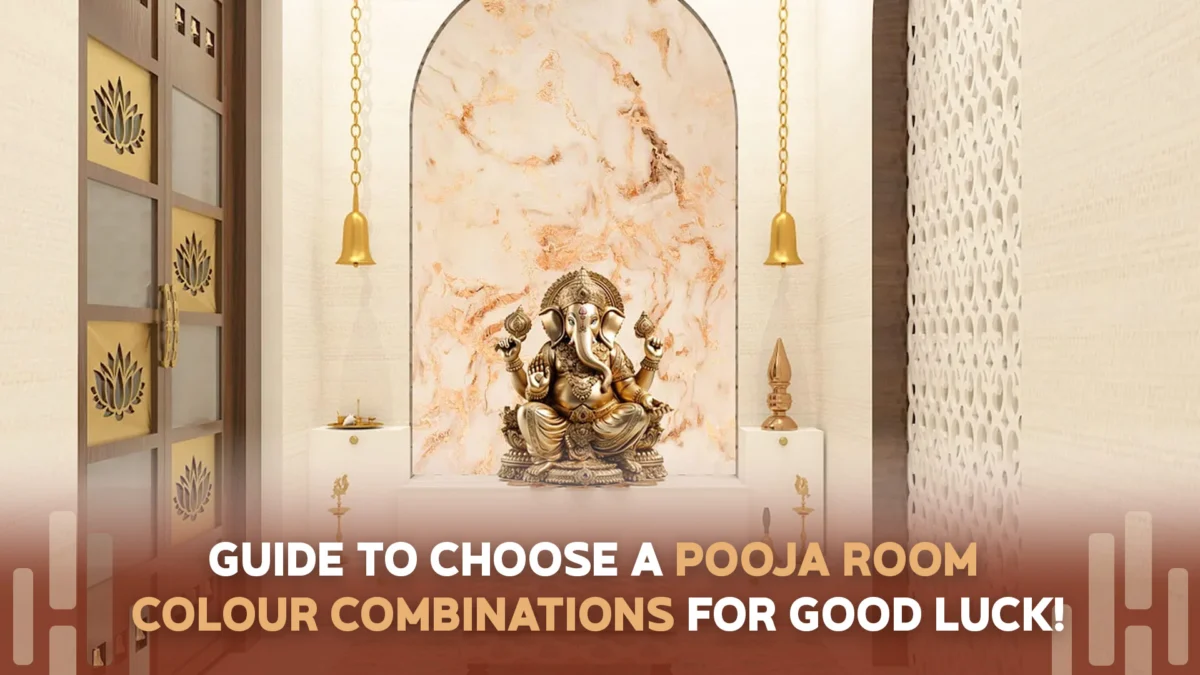
Pooja Room Colour Combinations That Feel Calm (Vastu-Friendly Ideas for Indian Homes)
Most families want the same thing from their pooja space. It should feel sacred and peaceful the moment you light the lamp. It should not feel dark, cramped or like a colour picked in a hurry twenty years ago. Getting there is harder than it looks, because pooja spaces in Indian apartments are usually small, often have no window, and live with daily diya smoke and incense.
This guide starts with the type of pooja space you have, then covers what Vastu commonly suggests by direction, eight calm combinations, the colours people regret, and a shopping checklist with approximate prices. Looking for traditional temple colours instead? Jump to temple palettes adapted for home mandirs.
A note on Vastu: many Indian homes follow it as traditional guidance, and we share what it commonly suggests. Your family’s own tradition matters just as much.
Start Here: What Kind of Pooja Space Do You Have?
The right colour depends mostly on the format of your mandir.
1. A separate pooja room (walk-in, with a door)
- You are colouring: all walls, the ceiling, the door and the idol wall.
- Best approach: a light base colour on three walls and the ceiling, and a deeper or textured shade from the same family on the wall behind the idols.
- Watch out for: windowless rooms. Keep the base light and warm so the room does not feel like a box.
2. A wall mandir or niche (in the living room, dining or a corridor)
- You are colouring: one wall or a recess, which must also suit the room around it.
- Best approach: keep the main wall close to your living room colour and make the niche the “special” zone with a back panel (laminate, CNC jaali, stone or a deeper paint shade).
- Watch out for: a bright saffron niche in a grey and white living room looks like an afterthought. Pick an accent that relates to your sofa, curtains or wood tones.
3. A pooja cabinet or modular unit (often in the kitchen or living room)
- You are colouring: mostly shutters and the inner back panel, not the wall.
- Best approach: a warm, light shutter finish (ivory, beige, light oak) with a richer inner back panel (walnut veneer, gold-toned jaali, soft saffron) so the idols glow when the doors open.
- Watch out for: high-gloss dark laminates inside the unit. They reflect the lamp flame and show every fingerprint and soot mark.
For made-to-measure options, see our modular pooja unit designs.
Pooja Room Colours by Direction (What Vastu Commonly Suggests)
Vastu guidance most often places the pooja space in the north-east (Ishanya), east or north. Here is what is commonly suggested for each, and what to adjust for real apartment conditions.
North-east facing pooja space
- Commonly suggested: white, cream, light yellow, and soft light blue.
- Combination we like: warm ivory walls, a pale haldi yellow idol wall, brass diyas and a white marble or quartz base.
- Apartment reality: in many Bangalore flats this corner sits deep inside the living room. With morning light, pale blue looks fresh. With almost none, skip blue (it turns grey and cold) and use cream or light yellow.
East facing pooja space
- Commonly suggested: white, light yellow, soft saffron and cream, linked with sunrise.
- Combination we like: cream walls with a muted saffron (not bright orange) idol wall, teak or light oak shelves, brass bells.
- Apartment reality: east light fades by late morning, so test your shade at night with the lamp lit, not only at noon.
North facing pooja space
- Commonly suggested: light green and light blue.
- Combination we like: soft sage or pista green with cream trims and light wood.
- Apartment reality: green looks muddy under cool white tubes. Use warm lighting and a green with a little yellow in it.
If your pooja space cannot be in these directions
Many apartment layouts do not allow it. Families then usually focus on keeping the space light, clean and well lit. Colour does a lot of the work wherever the mandir sits.
The Bangalore Apartment Factor: Light, Smoke and Humidity
Three things decide whether your chosen colour still looks good in a year.
- Low natural light. Many Bangalore pooja niches sit in an inner corner or corridor. Check the LRV (light reflectance value) on the shade card. Roughly 70 or above keeps a windowless niche bright. Shades under 40 look much darker than the swatch.
- Incense and diya soot. Daily agarbatti and lamps leave a grey film above the lamp line within months. Pure white shows it fastest; warm off-white, cream and soft yellow hide it better. Use a washable matte or eggshell (soft sheen) emulsion, and put stone, quartz, tile or metal directly behind the diya.
- Monsoon humidity. If the wall backs onto a bathroom or the outside, fix any damp and use an anti-fungal primer first, or the paint will blister.
Lighting tip: use warm white LEDs (2700K to 3000K), ideally CRI 90 or above. This makes brass glow and keeps idol colours true. Cool daylight bulbs (6000K to 6500K) make yellow walls look greenish and brass look flat.
8 Calm Pooja Room Colour Combinations (Walls + Accents + Materials)
1. Warm ivory + sandalwood + brass
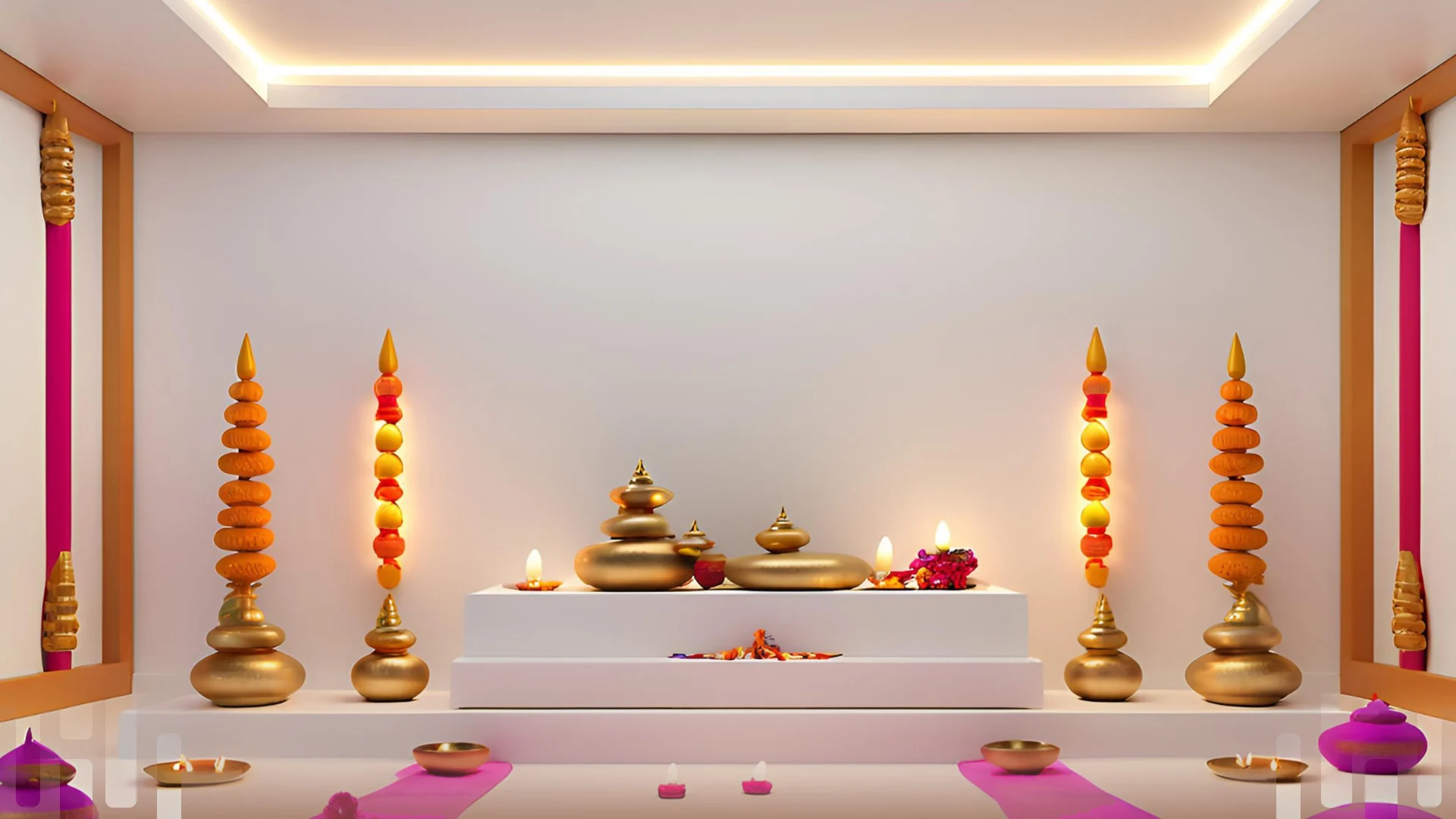
- Walls: warm ivory or off-white. Idol wall: soft sandalwood beige.
- Materials: brass diyas and bells, light teak shelf.
- Why it works: the safest calm option. It suits any direction, hides soot better than pure white and makes brass the focus. Works best for: small rooms and wall mandirs.
2. Pale haldi yellow + white trim + teak
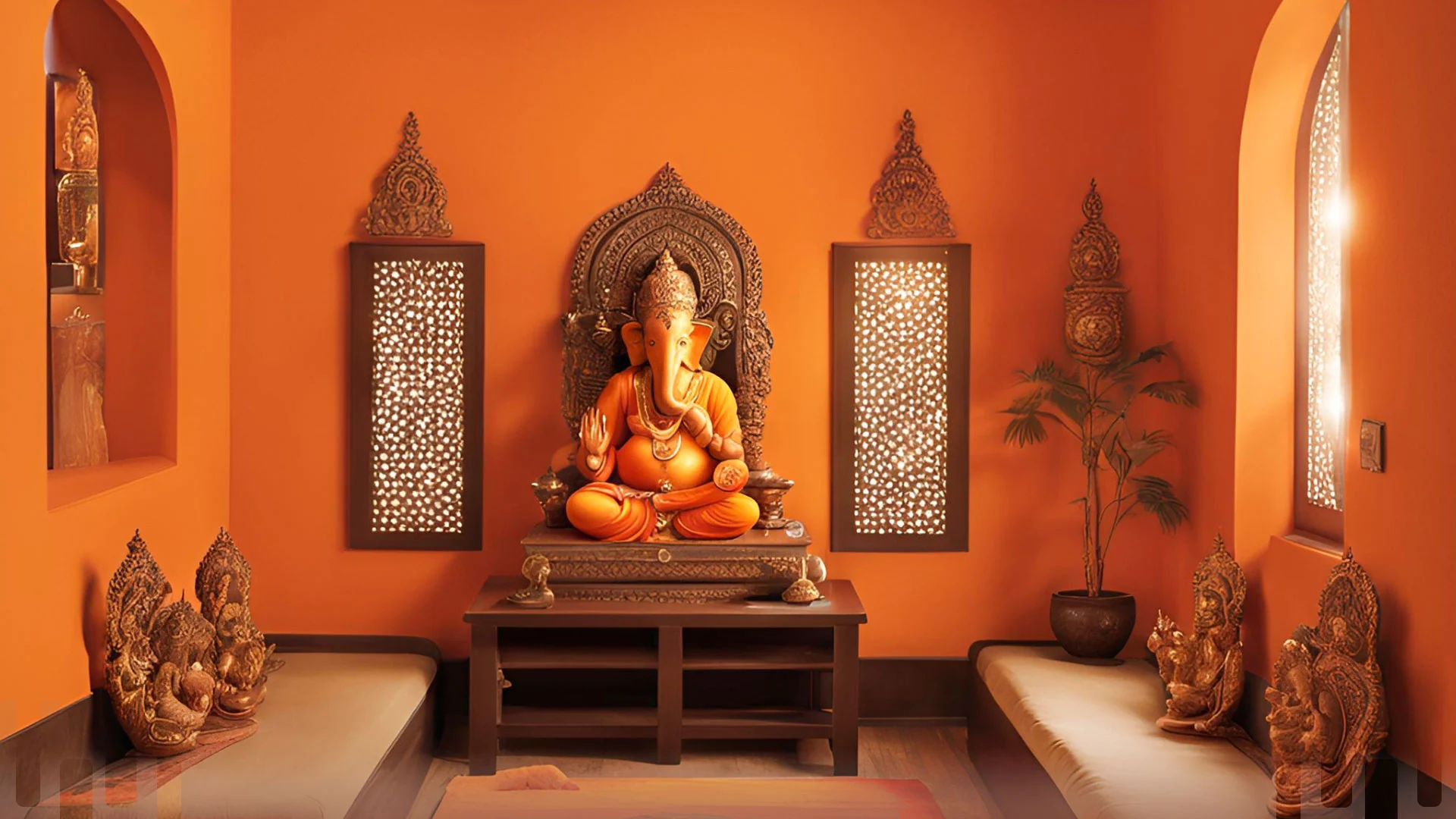
- Walls: pale turmeric yellow (a muted one, not lemon). Trim and ceiling: white.
- Materials: teak or honey oak, marigold garlands.
- Why it works: yellow is widely seen as auspicious and it brings warmth to rooms with little light. Works best for: north-east and east spaces, and compact pooja rooms.
3. Cream + muted saffron accent + brass
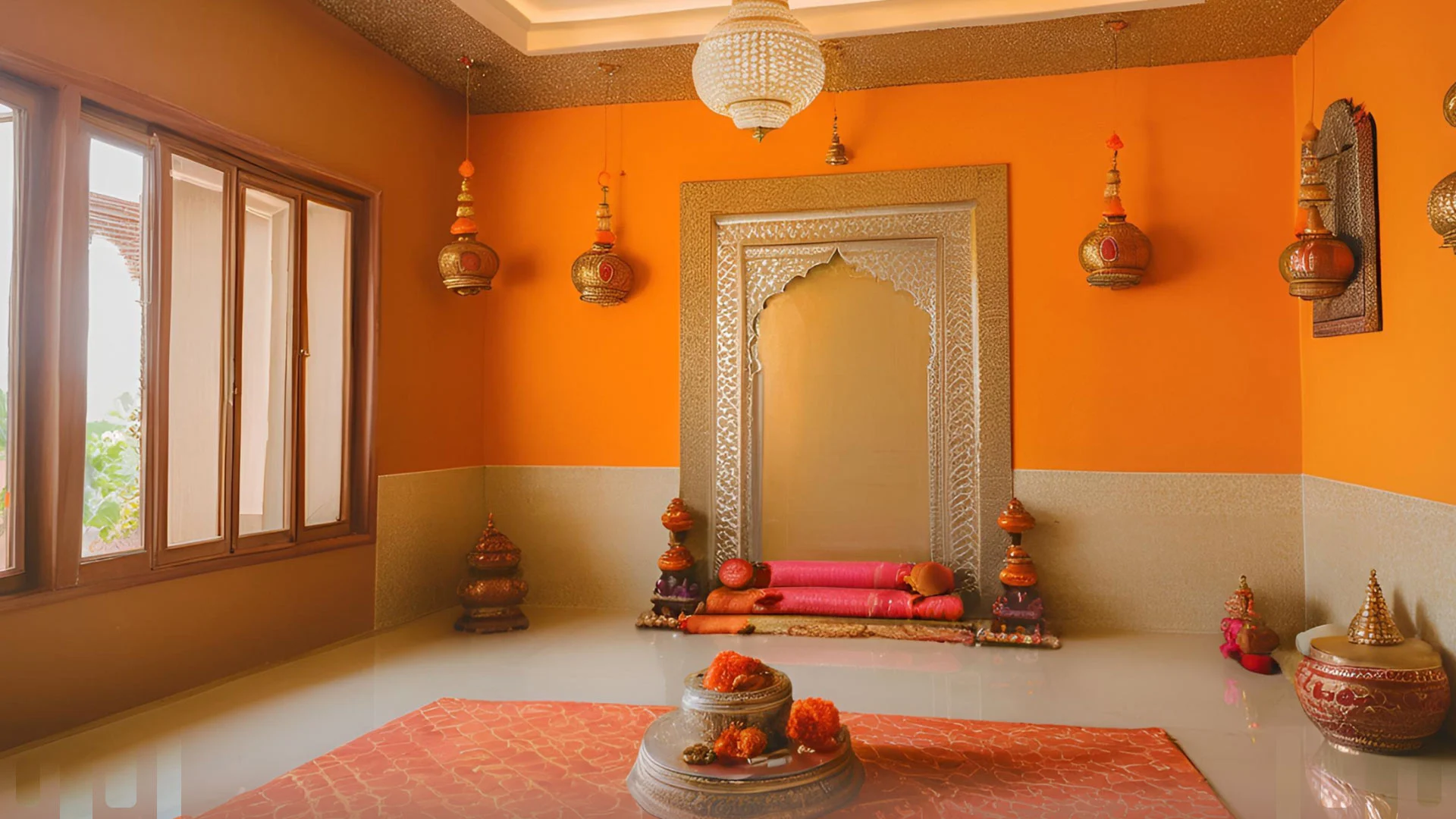
- Walls: cream. Idol wall: muted saffron or terracotta-orange in matte.
- Materials: brass, a dark wood frame for contrast.
- Why it works: you get the traditional orange and gold feel without the room feeling loud. Works best for: east-facing rooms and families who like a traditional look.
4. Powder blue + white + silver or brass
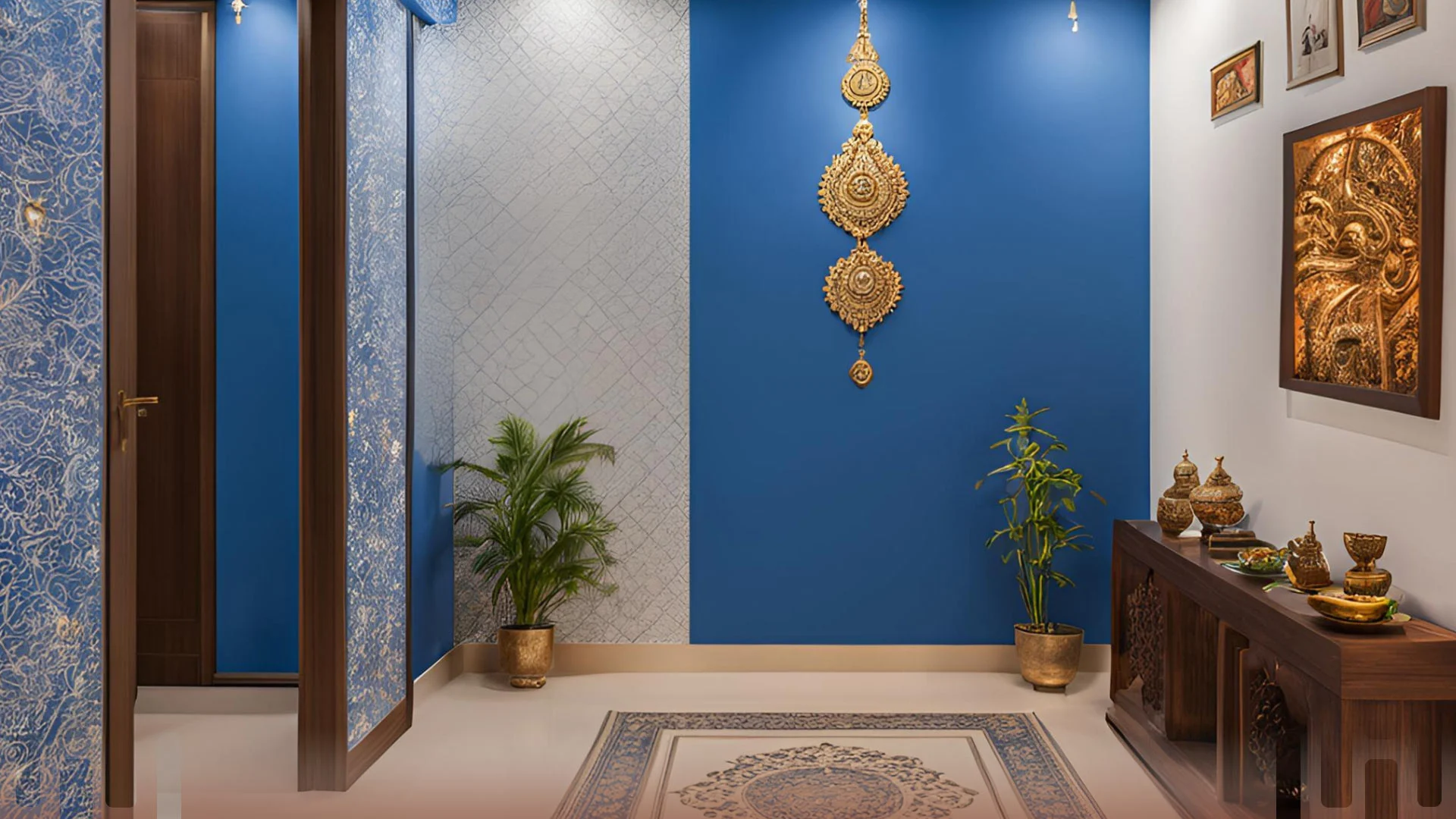
- Walls: powder or sky blue. Trims: white.
- Materials: white marble base, silver or brass accessories.
- Why it works: very serene for meditation. Works best for: north and north-east spaces that get real daylight. Avoid in windowless niches, where it looks cold.
5. Sage green + cream + light oak
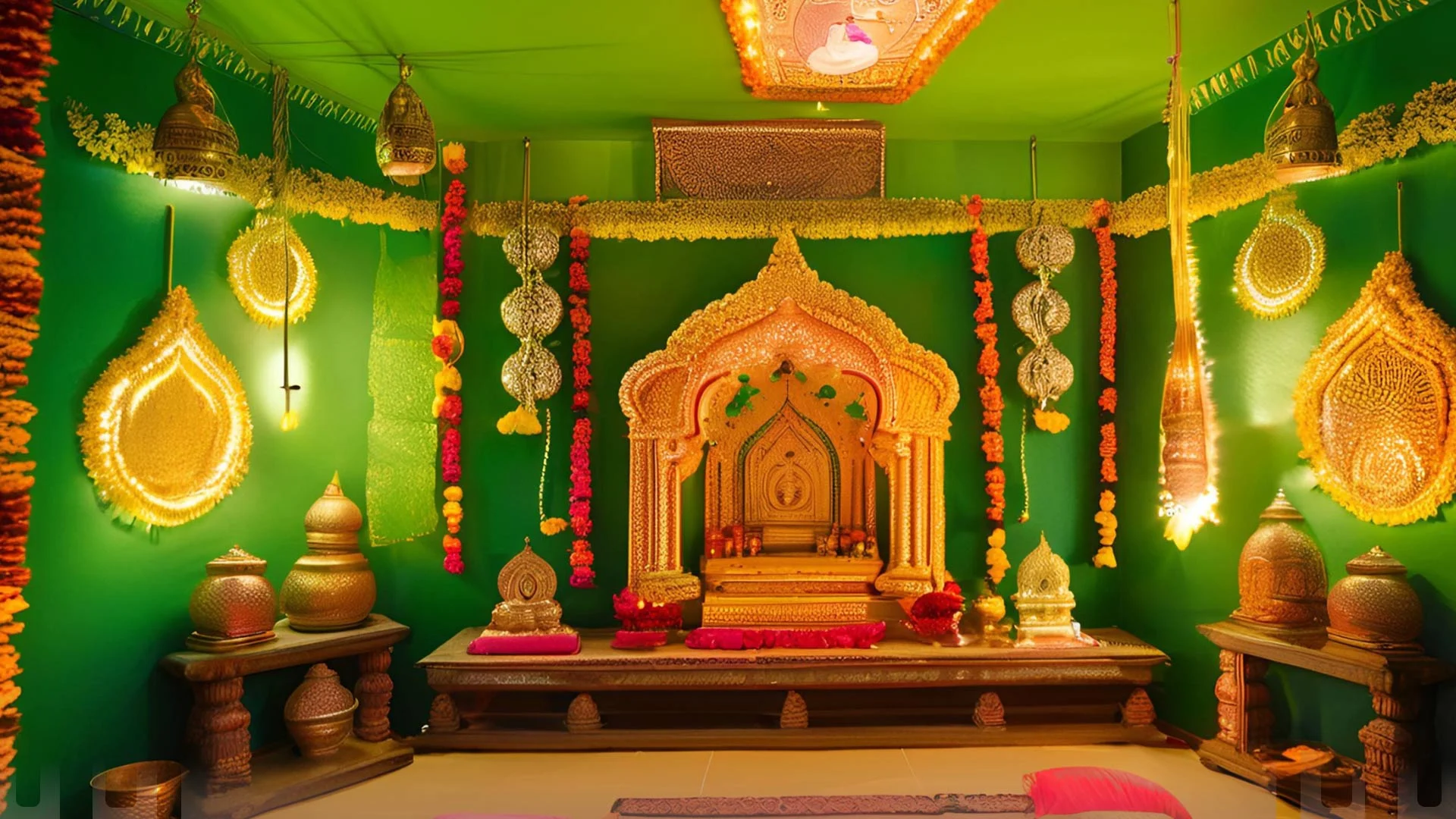
- Walls: soft sage or pista green. Trims: cream.
- Materials: light oak laminate, a small tulsi or money plant nearby.
- Why it works: fresh and modern while staying calm, and it suits contemporary living rooms. Works best for: north-facing wall mandirs.
6. Rose beige or peach + gold + white marble
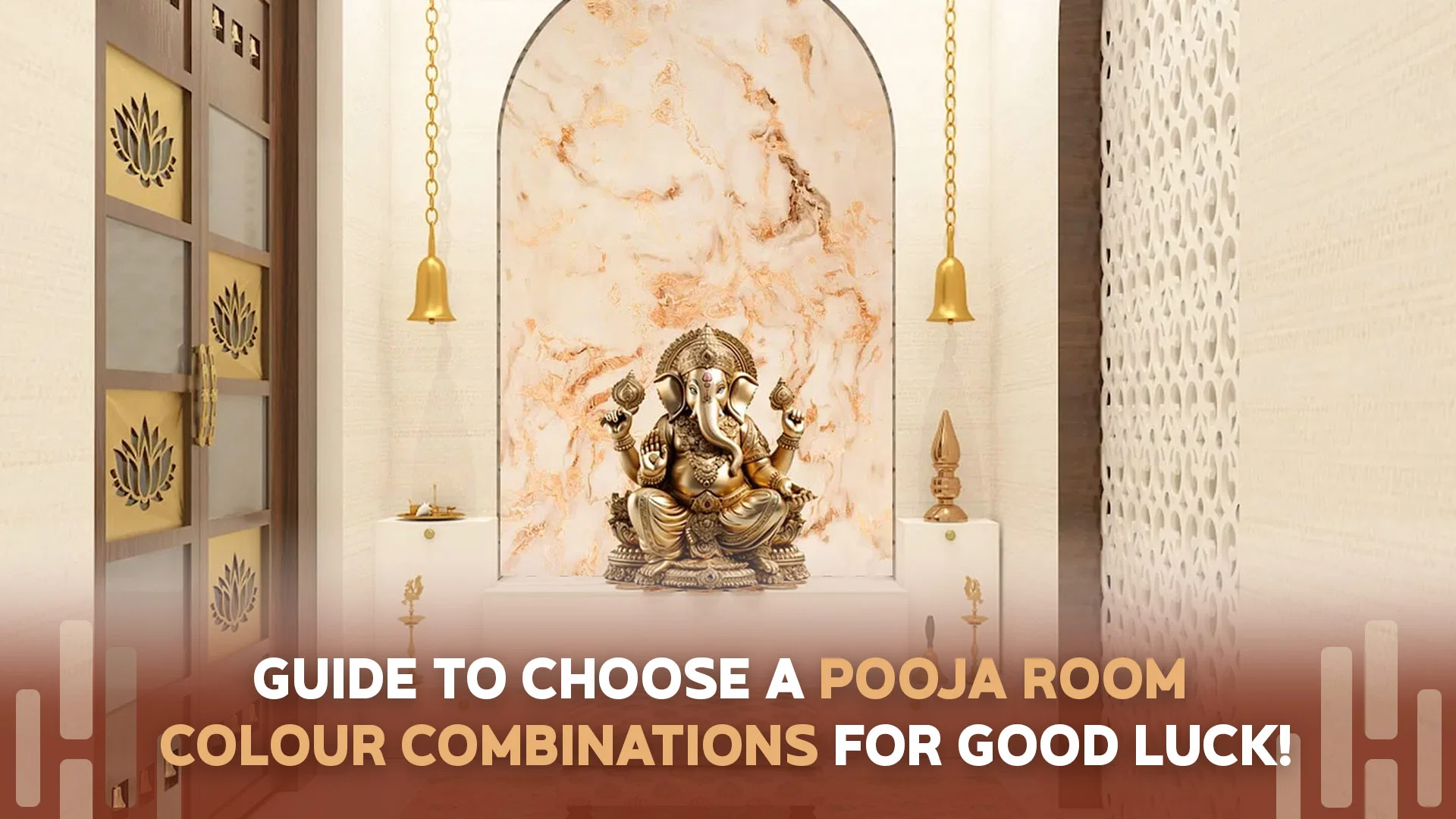
- Walls: rose beige or soft peach. Accent: gold-toned jaali or trim.
- Materials: white marble or quartz platform.
- Why it works: peach reads like early morning light and makes skin tones and idols look warm. Works best for: separate pooja rooms with a door.
7. Off-white walls + walnut back panel + brass jaali (for cabinets)
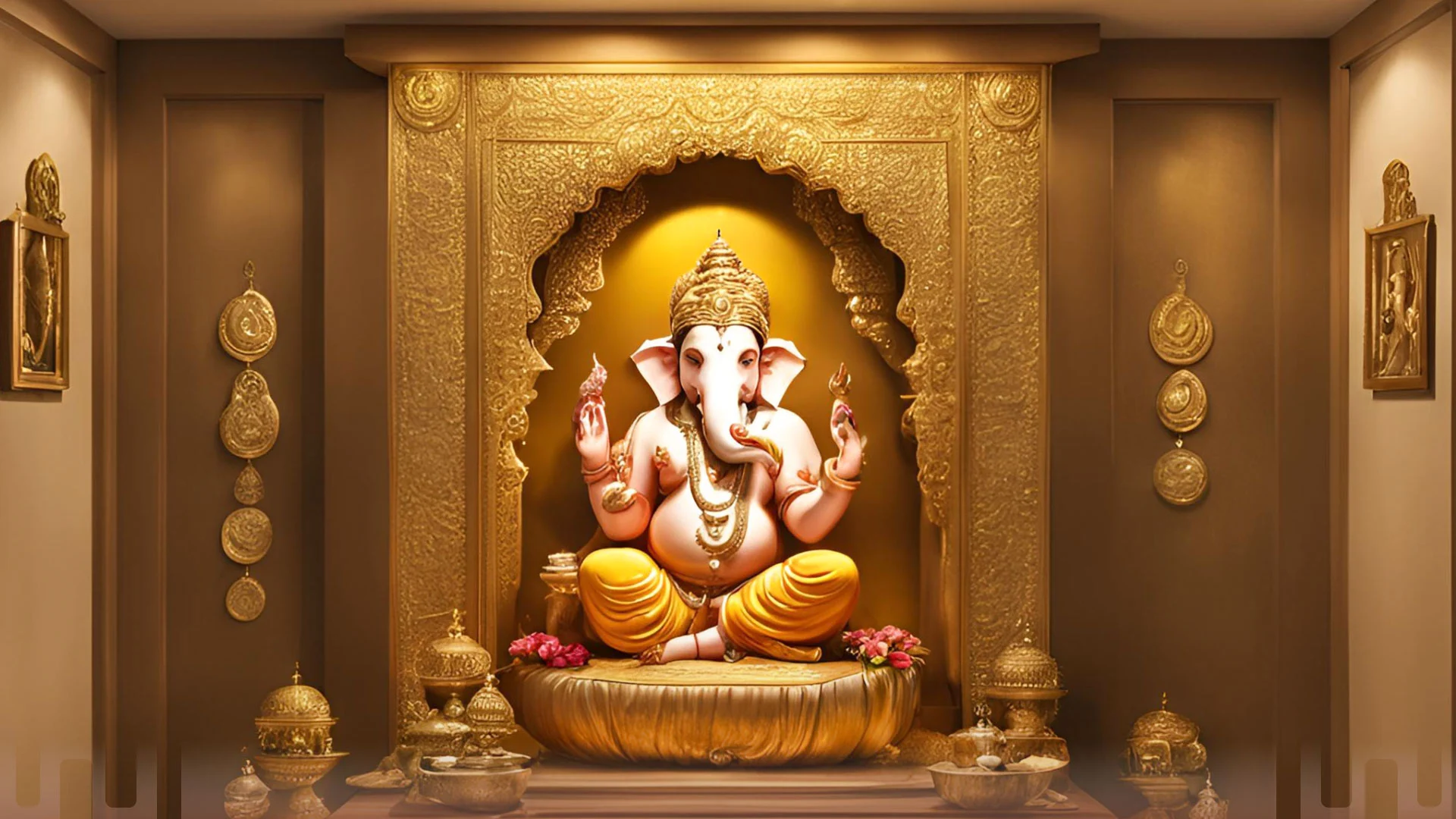
- Shutters: off-white or light oak. Inner back panel: walnut veneer or deep wood laminate.
- Materials: brass or gold-finish CNC jaali on the doors, warm LED strip on top.
- Why it works: the dark wood stays inside the unit, so the idols are framed without darkening the room. Works best for: modular pooja units.
8. Two-tone from one colour family
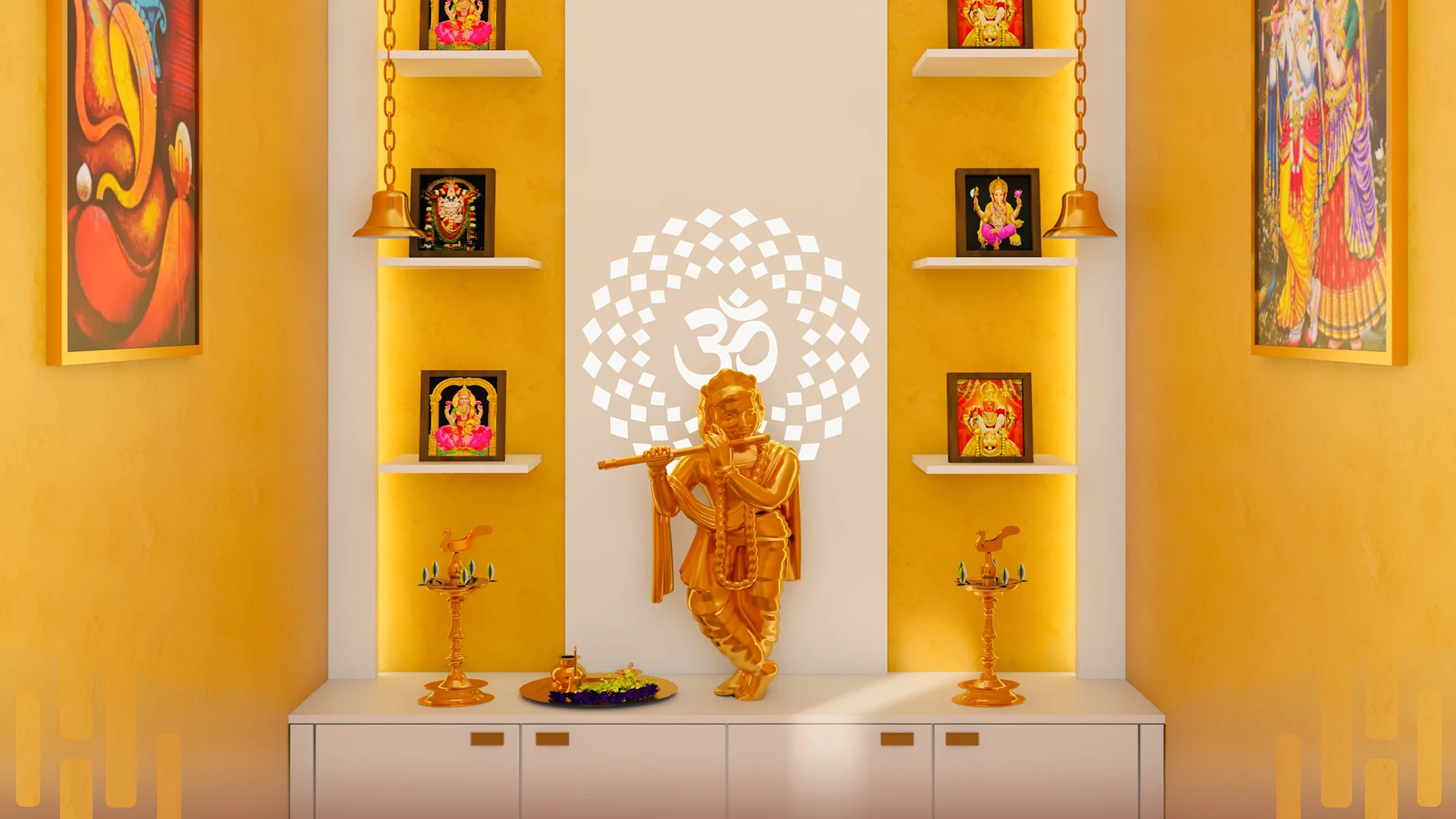
- Side walls: a light shade. Idol wall: two or three steps deeper on the same shade card strip.
- Why it works: depth without clashing, and the easiest combination to get right first time. Works best for: pooja units built between two walls.
Quick reference: other popular colours
- White: peaceful, but shows soot fast. Use warm white in a washable finish.
- Gold: best as metalwork, trims or jaali rather than a painted wall.
- Blue and white, green and gold: lovely in bright or larger rooms.
- Yellow and red, orange and gold: traditional and festive. Keep red and strong orange to accents in small rooms.
Pooja Room vs Temple Colours: Traditional Hindu Temple Palettes Adapted for Home Mandirs
A Hindu temple colour combination looks very different from a calm pooja room palette, and there’s a good reason. A temple is large, open to daylight, seen from across a courtyard, and built mostly from stone, lime, wood and metal. Your mandir is a few feet wide, lit by a diya and an LED strip, and seen from an arm’s length away. Paint a temple gopuram’s blues and reds onto a 3-foot niche and it will feel loud within a week.
You can still bring a temple’s character home. The trick is to borrow its palette through materials and small accents, and keep the walls around the idols light. Here’s how the major temple traditions translate.
Temple palettes, translated for a home mandir
| Temple tradition | Where you'll see it | Signature colours | What to borrow at home | Tone it down like this | Best for |
|---|---|---|---|---|---|
| Dravidian gopuram | Tamil Nadu and much of South India | Painted stucco figures in bright blue, red, yellow, green and pink. The inner sanctum is dark stone lit by oil lamps | A thin painted or tiled border around the niche in one gopuram colour (peacock blue or kumkum red), plus a dark granite base | One bright colour only, and keep it to a border, not the whole back wall | Wall niches in living rooms |
| Temple compound stripes | Outer walls of many South Indian temples, including in Karnataka | Vertical red-ochre and white stripes | Ochre-and-white stripes on the plinth or base of the mandir, or on the door frame of a pooja room | Use a matte terracotta or ochre, never a glossy red | Separate pooja rooms with a door |
| Kerala temple | Kerala and coastal Karnataka | White lime walls, red laterite stone, dark timber, copper or tiled roofs, brass lamps | Off-white walls, dark teak or walnut shutters, a tall brass lamp, terracotta or laterite-tone tile at the base | Keep the dark wood on shutters and frames; the back wall stays light | Modular pooja units and cabinets |
| Hoysala stone | Belur, Halebidu and Somanathapura, a day trip from Bangalore | Unpainted grey-green and dark grey soapstone, finely carved | A grey-green stone or sage laminate back panel, carved or CNC jaali detail, brass diyas | Warm 2700K lighting is essential, or grey-green turns cold. Keep side walls warm white | Contemporary flats with grey or white décor |
| North Indian marble | Rajasthan and Gujarat, including Jain temples | White marble, gold detailing, saffron flags | White or ivory marble or quartz base and back, gold-tone metal trims, a saffron cloth under the idols | Pick a warm white stone, not a blue-white one. Gold as metal, never as paint | Larger pooja rooms and marble mandirs |
| Sandstone temples | Khajuraho, Odisha and parts of Central India | Buff, honey and pinkish sandstone | Sandstone-beige or rose-beige wall in a textured or lime-plaster finish, terracotta accents | Matte texture hides diya soot well. Skip glossy finishes | Walk-in pooja rooms with some daylight |
| Bengal terracotta | Bishnupur and other parts of West Bengal | Fired terracotta brick, carved panels | A terracotta tile or brick-cladding panel behind the lamp, cream walls around it | Terracotta behind the diya also gives you a non-flammable backing | Wall mandirs with a daily diya |
How to borrow a temple palette without making the mandir feel loud
- Put the colour in materials first, paint second. Temples get their colour from stone, metal, wood and lime. Granite, brass, teak and terracotta age well near a lamp. A bright painted wall shows soot in months.
- One strong colour per mandir. If you love gopuram blue and kumkum red together, use one as the border and the other only in flowers, cloth or a garland.
- A rough split for a 3-foot wall mandir: about 70% light background (wall and back panel), about 20% wood or stone (shelves, frame, base), and no more than 10% strong colour (a border, a jaali, a cloth). It keeps the idols as the brightest thing you see.
- Gold is metal, not paint. Brass diyas, a gold-tone jaali or a thin metal trim catch lamplight the way temple gilding does. Gold paint on a wall usually looks flat.
- Test at night, with the lamp lit. Temple colours are judged in sunlight. Yours will be seen mostly at dawn and dusk, under a diya and warm LEDs.
- Respect your family’s tradition. Many families link colours to their deity, such as yellow for Vishnu and Krishna, red for Devi, or white for Shiva. If that matters to you, let it decide your one strong accent.
Which temple palette suits your mandir
- Walk-in pooja room in a villa or independent house: Kerala (white, dark wood, brass) or North Indian marble. You have the space for a stone base and a tall lamp.
- Wall niche in a living room: Hoysala grey-green or a single gopuram-colour border. Both sit well with modern sofas and grey or white walls.
- Modular pooja unit or cabinet: Kerala dark wood on the shutters, or a Bengal terracotta back panel inside. The strong material stays inside the unit, so the room around it stays calm.
- Windowless corridor niche (common in Bangalore apartments): sandstone-beige or rose-beige with a terracotta panel behind the diya. Avoid grey-green and blue here unless you have good warm lighting.
Colours and Choices That Cause Regret
- Black, charcoal or dark grey walls. Most Vastu guidance advises against them, and they make small spaces feel closed. If you like a black granite base, keep the walls light around it.
- Deep red on every wall. Red is sacred in many traditions, but on all four walls of a small room it feels heavy, and some Vastu guidance suggests avoiding it as the main colour. Use it as an accent.
- Bright white right behind the lamp. You will see a grey shadow above the diya within months. Use a backing panel and an off-white instead.
- High-gloss paint or laminate. It reflects the flame, looks harsh and shows fingerprints.
- Neon or very saturated shades. Fluorescent orange, electric blue and bright pink look striking in photos but tire the eye in person.
- Choosing from a swatch under shop lights. Shades look darker on a full wall in a dim niche.
- Dark brown everywhere. Dark shutters, walls and ceiling together make the mandir look smaller and older.
Shopping Checklist with Approximate Prices (India, 2026)
Ballpark figures only. Prices vary by brand, dealer and quantity, so confirm current rates before you buy. Treat all ₹ figures below as approximate — check with your dealer.
Paint
- Tester pots (about 50 to 200 ml): roughly ₹100 to ₹300 each. Buy two or three shades and paint A4-size patches on the actual wall.
- Premium washable interior emulsion (matte or eggshell): roughly ₹450 to ₹900 per litre. A small pooja room or one feature wall usually needs about 1 to 4 litres for two coats.
- Primer, plus anti-fungal primer on damp-prone walls: roughly ₹150 to ₹400 per litre.
- Painting labour in Bangalore: roughly ₹15 to ₹35 per sq ft with putty and primer. Many painters have a minimum visit charge for small jobs.
Laminates, panels and surfaces
- Decorative laminate (1 mm, 8 x 4 ft sheet): roughly ₹1,200 to ₹3,500 per sheet. Acrylic or high-gloss sheets cost roughly ₹3,500 to ₹8,000.
- Wood veneer (8 x 4 ft sheet): roughly ₹2,500 to ₹8,000 per sheet, plus polish.
- CNC jaali panel (MDF, painted or gold-finish): roughly ₹300 to ₹900 per sq ft. Metal jaali costs more.
- Stone or quartz base and diya backing: granite roughly ₹150 to ₹450 per sq ft, quartz roughly ₹300 to ₹800 per sq ft, installed prices higher.
Brass, lighting and finishing
- Brass diya pair: roughly ₹400 to ₹2,500. Brass bells: roughly ₹500 to ₹3,000.
- Brass handles or profile trims: roughly ₹300 to ₹1,500 per piece.
- Warm white LED strip with aluminium profile (2700K to 3000K): roughly ₹300 to ₹900 per metre, plus a driver at about ₹500 to ₹1,500.
- Modular pooja unit, made to measure: roughly ₹15,000 to ₹60,000 for a wall-mounted unit, and ₹40,000 to ₹1,50,000 or more for a floor unit with doors, drawers and jaali.
Before you buy, check
- The shade’s LRV on the shade card (aim for 70+ in dim spaces).
- The finish is labelled washable or stain-resistant.
- Your light colour temperature (2700K to 3000K).
- At least 15 to 20 cm between the diya flame and any laminate or wood, with a stone or metal tray under the lamp.
Frequently Asked Questions
Which colour is best for a pooja room as per Vastu?
Common Vastu guidance favours light, warm shades such as white, cream, light yellow and soft saffron. Light blue and light green are often suggested for north and north-east spaces. A warm off-white with brass and light wood is a calm choice that works almost anywhere.
Which colour should be avoided in a pooja room?
Most guidance advises against black, dark grey and very dark brown as the main colour. Deep red on all walls and neon shades also tend to feel heavy or restless in small spaces.
What colour is good for a wooden mandir?
Light walls such as cream, ivory or pale yellow make teak or walnut mandirs stand out. Avoid dark walls behind dark wood, because the unit will disappear.
Can I use two colours in my pooja room?
Yes. A light base with one deeper wall behind the idols is the easiest approach.
Which colour suits a small pooja room or corner?
Light yellow, warm white, cream or peach, because they reflect light and make the space feel larger.
What paint finish is best for a pooja room?
A washable matte or eggshell (soft sheen) emulsion works best. It hides wall flaws, does not glare under lamps and can be wiped when incense soot or oil marks appear. Keep a stone, quartz or metal surface directly behind the diya.
What is the traditional Hindu temple colour combination?
There isn’t just one. South Indian gopurams use bright painted blue, red, yellow and green, Kerala temples pair white lime walls with dark wood and brass, Hoysala temples are unpainted grey-green stone, and North Indian temples often use white marble with gold. At home, borrow one of these through materials and keep the walls light.

Planning a Pooja Space in Bangalore?
If you are designing a new pooja room, a wall mandir or a modular pooja unit, our designers at Q Oak Interiors are happy to help you pick colours, materials and lighting that suit your home and your family’s traditions. We work across Bangalore from our JP Nagar and Whitefield branches and build our units in our own factory. You can see our pooja room interior designs in Bangalore or book a free consultation whenever you are ready.